Quenching a Thirsty Planet – Teacher and Student Materials

Even though the Earth is a water planet, humans are faced with the issue of a lack of clean water. This unit centers on access to clean water and is driven by the major question: “What can we do to ensure that we have continuous and sufficient access to clean water?”

Students will learn about the water crisis from a global and local perspective, including uses, trends, and predictions concerning water health and access, current events and issues affecting water use and availability, and potential emerging solutions for the water crisis. Students will analyze public data, develop and articulate positions on the various facets of the water crisis, create and use scientific models to understand the scientific and social aspects of the issue, reflect on personal stewardship, and work toward potential solutions.

Unit Overview & Pacing Guide

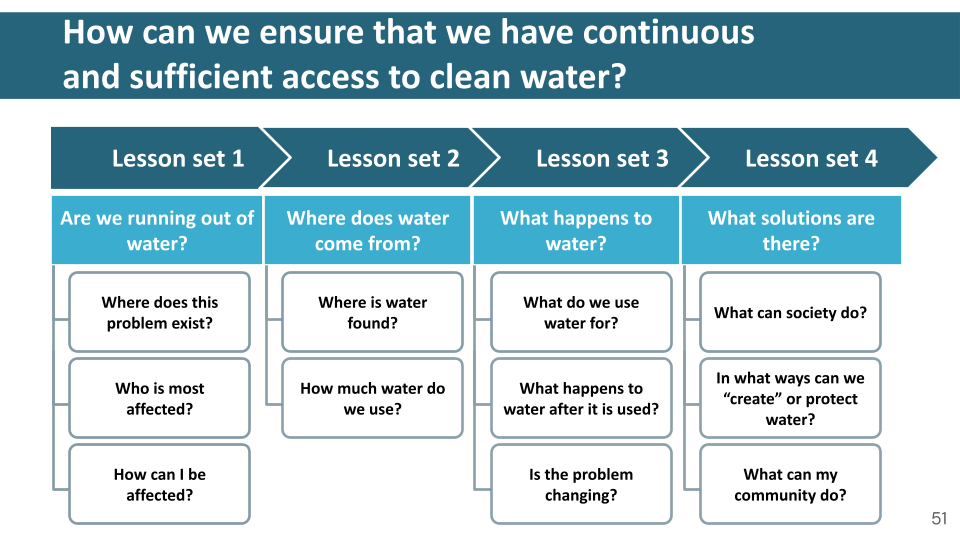
Storyline

How can we ensure that we have continuous and sufficient access to clean water?

Standards

North Carolina:

7. E. 1: Understand how the cycling of matter (water and gases) in and out of the atmosphere relates to Earth’s atmosphere, weather and climate and the effects of the atmosphere on humans.

  • 7.E.1.2 Explain how the cycling of water in and out of the atmosphere and atmospheric conditions relate to the weather patterns on Earth.

  • 7.E.1.3 Explain the relationship between the movement of air masses, high and low pressure systems, and frontal boundaries to storms (including thunderstorms, hurricanes, and tornadoes) and other weather conditions that may result. 

  • 7.E.1.4 Predict weather conditions and patterns based on information obtained from: Weather data collected from direct observations and measurement (wind speed and direction, air temperature, humidity and air pressure), Weather maps, satellites and radar, Cloud shapes and types and associated elevation.

  • 7.E.1.5 Explain the influence of convection, global winds and the jet stream on weather and climatic conditions.

  • 7.E.1.6 Conclude that the good health of humans requires: monitoring the atmosphere, maintaining air quality and stewardship.

NGSS:

ESS2.C: The Roles of Water in Earth’s Surface Processes

  • Water continually cycles among land, ocean, and atmosphere via transpiration, evaporation, condensation and crystallization, and precipitation, as well as downhill flows on land.

  • Global movements of water and its changes in form are propelled by sunlight and gravity.

  • Variations in density due to variations in temperature and salinity drive a global pattern of interconnected ocean currents.

Instructional Sequence

Guiding QuestionTopicTime
1.1 Where Does The Problem ExistIntroduce global scarcity of water.1 hour
1.2 How can I be affected?

Water goes from a source to taps through a series of steps.

Students will explore their local watershed and the possible impairments to it.

45 minutes
2.1 Where is water found?

Water is stored underground, on the surface and in the atmosphere.

There is very little accessible freshwater on Earth.

Water moves through Earth by the water cycle.

3 hours
2.2 How much water do we use?We use more water than we think in visible and invisible ways.1 hour
3.1 What do we use water for?Globally, water use is divided into three categories. From greatest use to least, it is (1) agriculture, (2) industry, and (3) municipal or household purposes. A country’s water use distribution is somewhat determined by how developed it is.1 hour
3.2 What happens after water is used?

After water is used, it is either treated in a water treatment plant (sewage) or it will runoff into the ocean.

Pollutants are collected during the runoff process, which can have harmful consequences on the health of a water system.

Urbanization and an increased need for agricultural areas can affect the water cycle.

3 hours
3.3 Is the problem changing?

Climate change and population growth play a significant role in the growing water crisis.

Policies, economics, and cultural habits contribute to the complex nature of the water crisis.

3 hours
4.1 What can society do?The water crisis is a complex problem with complex solutions, there are often many options, but not all of them are good choices for governments to make. 1.5 hours
4.2 How can we “create” freshwaterThe solutions to the water crisis will also involve technological innovations. These innovations come with affordances and constraints that must be considered when making decisions. 1.5 hours
4.3 What can I do?Review of the ways that personal decisions have an impact on the water crisis and ways governments and nonprofits encourage citizens to make water-smart choices. 15 minutes
Final projectDesign a plan for addressing an impending water crisis in your county by considering the economic resources, natural resources, and technological innovations that are available to you.2 hours

Introduce global scarcity of water.

1 hour

Water goes from a source to taps through a series of steps.

45 minutes

Water is stored underground, on the surface and in the atmosphere.

3 hours

Pedagogical Supports

Notes in blue are recommendations for timing. The recommendations offer additional activities or point out areas that can be cut if time is limited.

Notes in purple point out instructional support. For example, if the materials ask students to do a difficult task, a note in purple will guide the instructor through scaffolding that task. they are situated within the instructional sequence to provide in the moment support.

Notes in yellow are pointing out assessment opportunities. Assessment Opportunities are included in expendables and outline what to look for in the assessment along with how to use the assessment.

Notes in green highlight design principles and how the recommended activity support growth in this area. These notes also highlight skills or languagethe design principles use throughout the unit or all of Grand Challenges.

Call out discourse opportunities in red