Powering a Warming Planet – Teacher and Student Materials

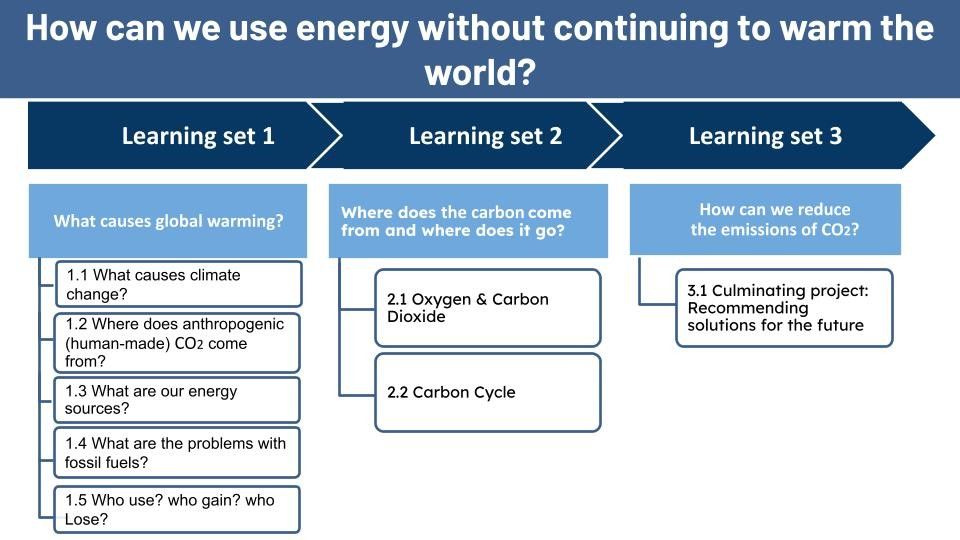
Fossil fuels are amazing substances. They provide the energy that keeps the world going. Yet, their ongoing use is causing global warming, which can lead to climate change and many other issues. This unit consists of three learning sets:

  1. Evidence for global warming is provided and a case is made that this is caused primarily by CO2. Most atmospheric CO2 comes from burning fossil fuels for energy.

  2. Why does burning fossil fuels emit CO2? This learning will track the carbon cycle and its relations with energy and all living things.

  3. The final learning set addresses the question, how can we reduce CO2 emissions? It presents ways to decrease energy use, alternative energy sources, recycle carbon from the atmosphere, the promise and weakness of each approach.


The unit emphasizes the use of public data, quantitative reasoning, and the disparities in energy use worldwide and builds students’ awareness of the importance of using science in addressing this grand challenge.

Unit Overview & Pacing Guide

Storyline

Standards

North Carolina:

7.P.2 Understand forms of energy, energy transfer and transformation and conservation in mechanical systems.

  • 7.P.2.1 Explain how kinetic and potential energy contribute to the mechanical energy of an object.

  • 7.P.2.2 Explain how energy can be transformed from one form to another (specifically potential energy and kinetic energy) using a model or diagram of a moving object (roller coaster, pendulum, or cars on ramps as examples). 

7.E.1 Understand how the cycling of matter (water and gases) in and out of the atmosphere relates to Earth’s atmosphere, weather and climate and the effects of the atmosphere on humans.

  • 7.E.1.6 Conclude that the good health of humans requires: monitoring the atmosphere, maintaining air quality and stewardship.

  • 7.L.1.4 Summarize the general functions of the major systems of the human body (digestion, respiration, reproduction, circulation, and excretion) and ways that these systems interact with each other to sustain life. 

NGSS:

PS3.B: Conservation of Energy and Energy Transfer

  • When the kinetic energy of an object changes, there is inevitably some other change in energy at the same time. (MS‐PS3‐5)

  • The amount of energy transfer needed to change the temperature of a matter sample by a given amount depends on the nature of the matter, the size of the sample, and the environment. (MS‐PS3‐4)

Instructional Sequence

Introduce global scarcity of water.

1 hour

Water goes from a source to taps through a series of steps.

45 minutes

Water is stored underground, on the surface and in the atmosphere.

3 hours

Guiding QuestionTopicTime
1.1 What causes climate change?

Introduce to the phenomenon of climate change and rise of atmosphere temperature;

Correlate the phenomenon of climate change, specifically, the rise of temperature, with the increase of atmosphere CO2

45 minutes
1.2 Where does  anthropogenic (human-made) CO2 come from?

Greenhouse effect;

The major sources of anthropogenic CO2 are from the burning of fossil fuels due to the use of energy.

60 minutes
1.3 What are our energy sources?

Major energy sources;

The transformation of energy (from kinetic and potential energy to electricity);

Fossil fuels (coal, oil, natural gas) and their importance;

Transition of energy sources during the past 150 years;

135 minutes
1.4 What are the problems with fossil fuels?

Issues caused by fossil fuels includes:

  • Rise of atmosphere CO2
  • Depletion of fossil fuels
  • Pollution and acid rain

Evaluating Online Scientific Sources

135 minutes
1.5 Who use? Who gain? Who lose?

Two issues about energy use:

  • Energy use and climate change
  • Energy poverty and climate injustice

Transition from coal. What makes it difficult?

45 minutes
2.1 Oxygen & Carbon DioxideGather evidence that burning fossil fuels and cellular respiration increase the amount of CO2 in the atmosphere, while photosynthesis decreases the amount of CO2 in the atmosphere.50 minutes
2.2 The Carbon CycleTo tie together the previous lesson (2.1) with the learning objectives of the first learning set to give a cohesive presentation of the carbon cycle.50 minutes
Final project  

Pedagogical Supports

Notes in blue are recommendations for timing. The recommendations offer additional activities or point out areas that can be cut if time is limited.

Notes in purple point out instructional support. For example, if the materials ask students to do a difficult task, a note in purple will guide the instructor through scaffolding that task. they are situated within the instructional sequence to provide in the moment support.

Notes in yellow are pointing out assessment opportunities. Assessment Opportunities are included in expendables and outline what to look for in the assessment along with how to use the assessment.

Notes in green highlight design principles and how the recommended activity support growth in this area. These notes also highlight skills or languagethe design principles use throughout the unit or all of Grand Challenges.

Call out discourse opportunities in red