Feeding a Hungry Planet – Teacher and Student Materials
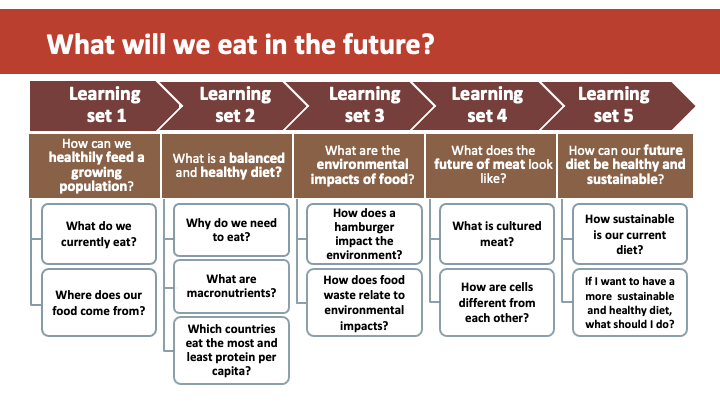
This unit raises the question, what will we eat in the future? It addresses the challenges to our diets and changes that we expect to see occurring. The unit consists of five learning sets, each driven by a different question:
How can we feed our growing population?
What is a balanced and healthy diet?
What is the problem with meat production?
What does the future of meat look like?
How can the diet of our future be both healthy and sustainable?
In the unit, students learn about local and global food production and agriculture by tracking the making of a pizza and a hamburger, discuss the basics of nutrition, focusing in particular on micronutrients and proteins, then focus on the environmental challenges of meat production, and consider cutting-edge technologies involved in the production of cultured meat. The unit solicits students’ visions regarding the future of food, emphasizing personal agency.
Unit Overview & Pacing Guide
Storyline
Standards
North Carolina:
7.L.1 Understand the processes, structures and functions of living organisms that enable them to survive, reproduce and carry out the basic functions of life.
7.L.1.1 Compare the structures and life functions of single-celled organisms that carry out all of the basic functions of life including:
Euglena
Amoeba
Paramecium
Volvox
7.L.1.2 Compare the structures and functions of plant and animal cells, including major organelles (cell membrane, cell wall, nucleus, chloroplasts, mitochondria, and vacuoles).
7.L.1.3 Summarize the hierarchical organization of multi-cellular organisms from cells to tissues to organs to systems to organisms.
7.L.1.4 Summarize the general functions of the major systems of the human body (digestion, respiration, reproduction, circulation, and excretion) and ways that these systems interact with each other to sustain life.
NGSS:
LS1.A: Structure and Function
All living things are made up of cells, which is the smallest unit that can be said to be alive. An organism may consist of one single cell (unicellular) or many different numbers and types of cells (multicellular). (MS-LS1-1)
Within cells, special structures are responsible for particular functions, and the cell membrane forms the boundary that controls what enters and leaves the cell. (MS-LS1-2)
In multicellular organisms, the body is a system of multiple interacting subsystems. These subsystems are groups of cells that work together to form tissues and organs that are specialized for particular body functions. (MS-LS1-3)
Notes in blue are recommendations for timing. The recommendations offer additional activities or point out areas that can be cut if time is limited.
Notes in purple point out instructional support. For example, if the materials ask students to do a difficult task, a note in purple will guide the instructor through scaffolding that task. they are situated within the instructional sequence to provide in the moment support.
Notes in yellow are pointing out assessment opportunities. Assessment Opportunities are included in expendables and outline what to look for in the assessment along with how to use the assessment.
Notes in green highlight design principles and how the recommended activity support growth in this area. These notes also highlight skills or languagethe design principles use throughout the unit or all of Grand Challenges.